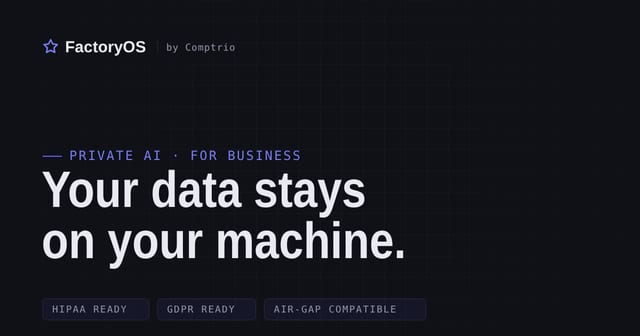
Private AI for the Family Office
Someone you trust likely pointed you here. That is how a family office finds anything worth its time, and it is the spirit in which this is written.
A family office runs on discretion, continuity, and a very short list of people allowed to know things. Most AI tools quietly fail all three, because the moment you use them the family's information leaves the building.
FactoryOS is the other kind. It is a private artificial intelligence that lives on the family's own hardware, answers only to the principal's rules, and never sends a word of the family's affairs anywhere.
Your Data Never Leaves
Nothing the family tells this system ever leaves the family's own hardware. There is no cloud account on the other end and no app quietly keeping a copy.
The AI runs on a single appliance that sits in your office. It ingests your documents and correspondence and serves answers from that one box, so no outside account ever holds your balance sheet, your trust structures, or the principal's calendar.
There is no vendor to be breached, subpoenaed, or to train on what it reads. For families who want nothing touching the outside network at all, the appliance can be delivered air-gapped, by hand, with source and key held in escrow.
Access Stays With The Principal
The principal decides who sees what, and the system enforces it down to the individual. Need-to-know is the default, not a setting someone has to remember.
The household manager can hold the calendar and travel without ever seeing the portfolio. The CPA's channel holds tax matters and not the estate correspondence, and outside counsel sees only what counsel is given.
Each person, including every advisor, works in their own segment of the brain. Only the principal sees across all of it.
Memory That Outlasts Staff
When a long-serving executive or assistant retires, their knowledge usually walks out with them. Here it stays with the family.
Every person, decision, document, and relationship is held in a knowledge graph that remembers how things connect and why. Who introduced you to which banker, the reasoning behind a trust decision, which manager handles which entity.
That memory carries across staff turnover and across generations. The next principal inherits the family's institutional knowledge instead of rebuilding it.
A Principal Always Prepared
The assistant reads ahead so the principal walks into every meeting already briefed. Each morning it prepares a quiet summary of the day's schedule and what matters in it.
Before a call with a manager, an attorney, or a banker, it surfaces who they are, your history with them, and the open threads. All of it is drawn from the family's own records rather than a public profile.
It reaches the principal however the principal prefers, by chat, by email, or by voice. Every word of it is spoken and stored locally.
The Routine Runs Itself
The repetitive machinery of an office can run on its own, with a person approving anything that counts. Reporting, document chasing, and coordination stop depending on someone remembering to do them.
Consolidating statements across custodians, gathering the quarter's K-1s, reconciling bill pay and property expenses, keeping advisors moving in step. These become workflows that fire on schedule and do the gathering for you.
Nothing irreversible happens without sign-off. Any action that touches money or a commitment arrives as a clear request with the agent's reasoning attached, for a person to approve or decline.
Owned, Not Rented
You own the system outright, the way the family owns its other assets. It is not a subscription that can be revoked or its terms rewritten.
It is bought once, installed, and yours, the hardware and the software that runs it. There are no per-seat fees and no meter on how much the family uses it.
No platform can change terms, read your data, or disappear and take the family's memory with it. Ownership is the point, and it tends to sit well with how a principal already thinks about custody and control.
A Private Next Step
The right next step is a quiet conversation, not a purchase. There is no campaign here and no reason to hurry.
An engagement begins with a private needs interview, scoped to how the family actually works and how much it expects to use the system. From there the office is configured to fit and the appliance is set up for you.
If it is a fit, the person who sent you can tell you it has already been one for them.